


A new report from Ookla has some interesting findings about the state of 5G in Malaysia. It seems our median download speed has almost halved from its peak towards the end of 2023.
Malaysia’s 5G rollout, built on the single wholesale network run by Digital Nasional Berhad (DNB), was a sprint out of the gates. It initially catapulted us into the ranks of the world’s fastest, with a blistering median download speed of 451.79 Mbps. But as the network has matured and millions more users have hopped on, those speeds have settled. By the third quarter of this year (2025), the median had dipped to 242.92 Mbps. Upload speeds have followed a similar trend, easing back from nearly 50 Mbps to just under 30.
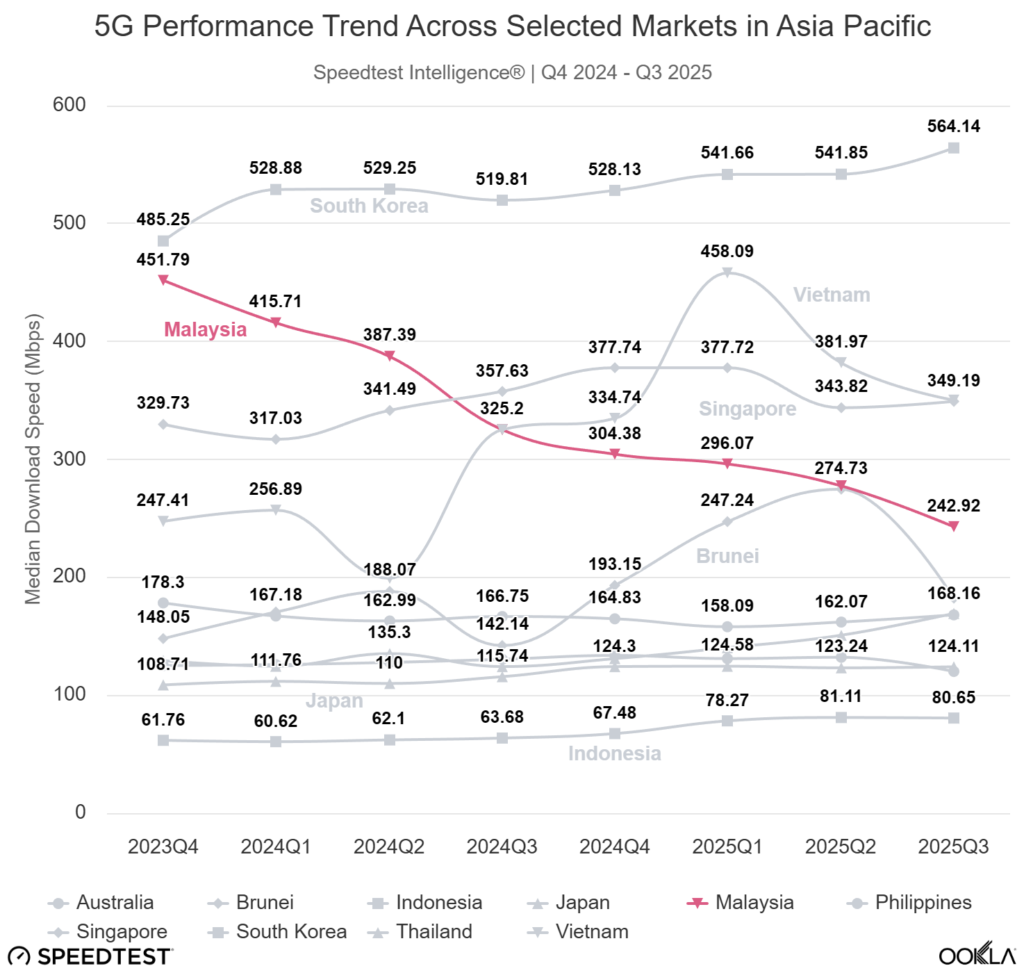
Now, it’s not all bad news. As Ookla points out, our performance is still pretty competitive. We’re comfortably ahead of regional neighbours like Japan, the Philippines, and Thailand. But we have fallen behind the frontrunners, notably South Korea and our neighbour Singapore, which is posting a median of 349.19 Mbps.
The report pinpoints a key issue behind the experience: coverage gaps. While most new phones are now 5G-ready, and about 80% of speed tests are run on them, users are still spending nearly two-thirds of their connected time on 4G networks. The culprit is patchy coverage, especially indoors and in more rural areas, which constantly pushes devices back to the older network.
In response to this report, the Malaysian Communications and Multimedia Commission (MCMC) offered a crucial bit of context for those headline speed figures: explosive growth. The regulator revealed that the number of 5G subscribers in Malaysia hasn’t just grown – it’s skyrocketed, jumping from 4.6 million in November 2023 to a staggering 28.7 million by November 2025.
As the commission noted, “While such observations provide useful reference points, MCMC emphasises that headline speed measurements must be viewed in the context of rapid network expansion and accelerated user adoption.” Essentially, the network is handling a vastly larger crowd than it was during its peak speed tests, which naturally changes the performance picture.