


Nvidia just announced RTX Spark, a brand-new chip designed for Windows PC platform built around a Grace Blackwell superchip. This isn’t just another discrete graphics card to slot into your motherboard; Nvidia is diving headfirst into the consumer processor market with a full system-on-chip design.

Aimed squarely at AI agents, content creation, and gaming, we can expect to see these chips powering ultra-slim Windows laptops and compact desktops as early as this autumn.
Because RTX Spark is Arm-based silicon, traditional x86 Windows apps will have to rely on Microsoft’s Prism emulator unless native Arm versions are available. To make the transition smoother, Nvidia and Microsoft are teaming up to build a native Windows platform for AI agents. Nvidia is calling its runtime OpenShell, while Microsoft is handling the security side, adding containment features so your local AI agents can run safely under your control.
Under the hood, it packs a Blackwell RTX GPU with 6,144 CUDA cores and fifth-generation Tensor Cores with FP4 support, delivering up to 1 petaflop of FP4 AI performance. The graphics side is hooked up via NVLink-C2C to a 20-core Grace CPU, which Nvidia custom-built alongside MediaTek. This setup is actually a close relative of the GB10 chip found in their heavy-duty DGX Spark data centres.
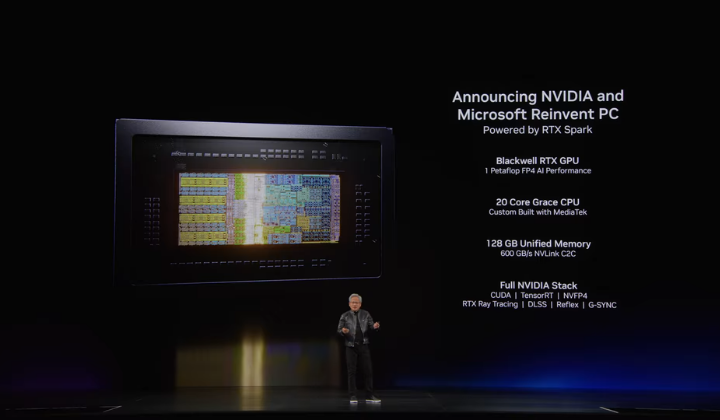
For memory, the top-tier RTX Spark configuration supports up to 128GB of LPDDR5X unified memory. Thanks to that NVLink-C2C connection, you get a massive 600 GB/s of GPU-to-CPU bandwidth, which Nvidia points out is five times faster than standard PCIe Gen5. All that bandwidth means these machines can locally run massive 120-billion-parameter language models with up to a million tokens of context. For creatives, Nvidia claims it can handle 90GB 3D scenes, edit 12K video, and generate 4K AI video without breaking a sweat.
Of course, it wouldn’t be an Nvidia chip without some gaming capabilities. The platform comes loaded with RTX ray tracing, DLSS, Reflex, and G-Sync. Nvidia is promising that these PCs can easily run AAA games at 1440p and over 100 FPS with all those features switched on, similar to a RTX 5070 GPU. Software support looks promising too, with Adobe already reworking Photoshop and Premiere for the new platform, alongside native Arm support coming from big names like Blender, DaVinci Resolve, CapCut, and Cubase.
You will be able to get your hands on this hardware in 14-inch to 16-inch laptop designs, with some chassis measuring as thin as 14 mm and weighing just 1.36kg. Some premium models will even feature tandem OLED panels with G-Sync.
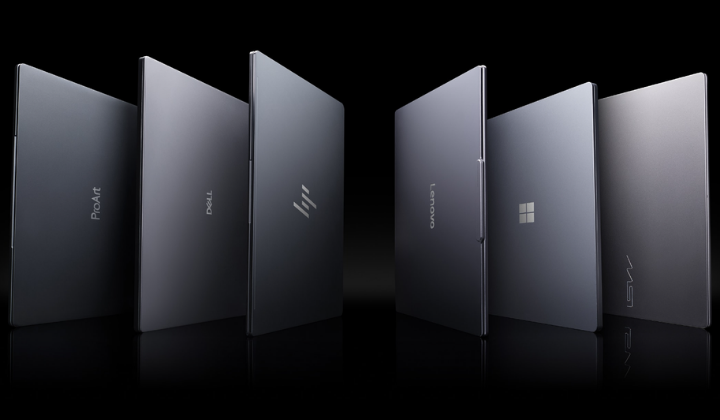
Big-name manufacturers like Asus, Dell, HP, Lenovo, Microsoft Surface, and MSI are all lined up to release systems first, with Acer and Gigabyte following later. The RTX Spark will also be available in mini PCs.
Nvidia is keeping quiet on the exact pricing for now, but considering the ongoing global memory shortage, do not expect these to be anywhere near as affordable as a MacBook Neo.