

Qualcomm has just lifted the curtain on its next-gen XR (Extended Reality) chip, the Snapdragon Reality Elite, and it is designed to power both high-performance all‑in-one video-see-through headsets and lightweight tethered smart glasses.
The big talking point here is the onboard AI. With up to 48 TOPS of processing power, it can handle advanced generative AI models, large language models, and vision models right on the device, paving the way for far more personalised and responsive virtual experiences.
The performance jumps are pretty wild compared to the older Snapdragon XR2+ Gen 2. Qualcomm is claiming up to 30% boost in CPU performance, up to 60% jump for the GPU, and up to 160% increase for the NPU.
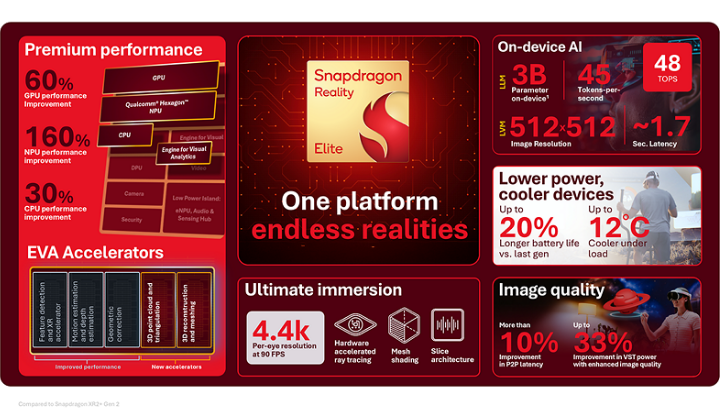
For anyone worried about battery life and overheating, Qualcomm says they have optimised power consumption across the board. The chip runs up to 12°C cooler under heavy load and stretches battery life by up to 20% for the same workload, meaning longer, more comfortable sessions without your headset turning into a forehead heater.
On the visual side, it supports a crisp 4.4K resolution per eye at 90 FPS, which should translate to incredibly sharp details and smooth motion. Qualcomm has also focused heavily on reducing video-see-through latency to make digital objects blend seamlessly with the real world.
They have achieved this by baking in dedicated hardware acceleration for heavy computer vision tasks, which basically means less lag and a much more convincing mixed reality experience. Plus, it plays nicely with connected gear, supporting simultaneous display, input, and charging.
The first device to adopt this chip is the XREAL Project Aura glasses, running on Android XR, which is launching later this year.