

After dropping their flagship Dimensity 9500 back in September, MediaTek has already followed it up with a refreshed version called the Dimensity 9500s. To keep things interesting for those not looking to spend flagship money, they have also launched the mid-range Dimensity 8500 alongside it.
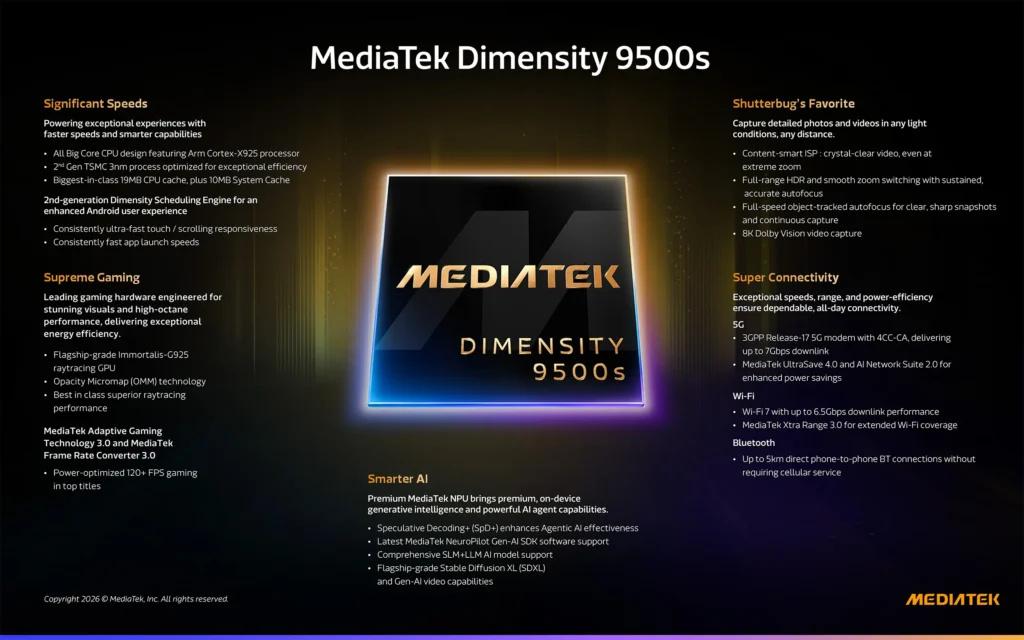
The new 9500s is less powerful than the 9500. It is sporting a primary Arm Cortex-X925 Ultra core that can hit speeds of 3.73GHz. You also get a mix of 3x Arm Cortex-X4, and 4x Arm Cortex-A720 to keep things running smoothly. The Dimensity 9500 has a different and more powerful cores. It features 1x C1-Ultra clocked at 4.21GHz, 3x C1-Premium, and 4x C1-Pro.
On the graphics side, there is an Immortalis-G925 GPU that is built for fancy ray tracing and adaptive gaming. Plus, there is a serious NPU tucked inside to help with all those generative AI tasks.
On the imaging front, it uses the Imagiq processor to handle real-time motion tracking and 8K video at 60fps with Dolby Vision. It can even support massive 320MP camera sensors if manufacturers decide to go that big. If you are a fan of super-smooth screens, it will drive WQHD+ displays at a nippier 180Hz. It is also fully kitted out with the latest connectivity, including Wi-Fi 7, Bluetooth 5.4, and plenty of power-saving tech to make sure your battery does not give up the ghost halfway through the day.
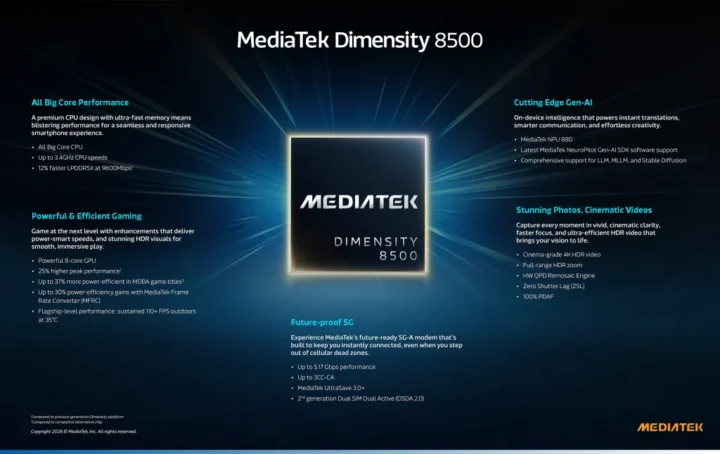
Moving over to the Dimensity 8500, this one is aimed at the mid-range market but still borrows some of that big-core energy. It is built on an efficient 4nm process and uses eight Cortex-A725 cores. MediaTek reckons the Mali-G720 GPU inside offers a 25% jump in performance while being significantly more efficient than the previous generation. It also gets an 8th-gen NPU that can handle most AI tasks.
Even though it is the more affordable sibling, the 8500 still supports 320MP cameras and 4K video recording. You will get Wi-Fi 6E and the same comprehensive satellite support found in the flagship chip, along with dual SIM 5G. It supports a slightly lower 144Hz refresh rate, but for most people, that is still plenty fast for a fluid experience.
We should start seeing these chips popping up in new smartphones fairly soon, so it is worth keeping an eye out if you are due for an upgrade.