

MediaTek just announced the release of not one, but two new flagship mobile processors: the Dimensity 9600 Pro and the Dimensity 9600M.
MediaTek Dimensity 9600 Pro
Starting with the heavy hitter, the top-tier Dimensity 9600 Pro is built on TSMC’s cutting-edge 2nm process. It packs an All Big Core layout featuring two Arm C2-Ultra cores pushed to 4.55GHz, three tweaked Arm C2-Pro cores running at 4.35GHz, and another three C2-Pro cores at 3.10GHz. MediaTek stacked this silicon with 34.5MB of total cache across L2, L3, and SLC, alongside support for next-gen LPDDR6 RAM and UFS 5.0 storage.
On the graphics front, the Arm Mali G2-Ultra NX GPU brings serious gaming firepower, boasting 185FPS capabilities, MediaTek’s Neural Network Rendering Architecture, a 3rd-Gen Ray Tracing Engine, Frame Rate Converter 4.0, and advanced Ray Tracing Pipeline Tech. This brings a 27% jump in peak GPU performance, a 24% boost in power efficiency, and up to 18% faster hardware ray tracing.
Artificial intelligence gets a massive overhaul with the dual-engine setup. The main NPU 1090 is paired with a second-gen Ultra-Efficient NPU, running Generative AI Engine 3.0 and Agentic AI Engine 3.0. This allows the chip to run local AI MoE models up to 30B directly on-device with twice the INT4 compute output. The main NPU speeds up LLM prefill by 51% while boosting token generation efficiency per watt by 55%. Meanwhile, the background low-power NPU sips 40% less energy for continuous sensing duties. Local AI launch speeds are up 27% overall, and token generation rates leap by 40%.
Cameras and displays get plenty of love too, thanks to the Imagiq 1290 ISP, which enables 4K recording at a silky 240FPS for ultra-fast slow-mo, alongside a dedicated 4K 60FPS movie mode. You also get Panel OverDrive multi-frame compensation and a colour range 38% wider than standard DCI-P3. Wireless connectivity covers both sub-6GHz and mmWave 5G with Tri-SIM Tri-Standby, plus Bluetooth 6.2.
All up, these hardware tweaks deliver a 17% bump in single-core speeds and a 15% boost in multi-core throughput, backed by a 21% larger L2 cache. Energy efficiency is the real winner, showing 37% better single-core efficiency and cutting multi-core peak power usage by up to 61%. Memory speeds scale right along with it, as LPDDR6 provides 33% more effective bandwidth, while UFS 5.0 doubles the throughput of standard dual-channel UFS 4.0.
MediaTek Dimensity 9600M
Moving on to the Dimensity 9600M, this chip uses the older TSMC’s 3nm process and functions more like a refined upgrade to the older Dimensity 9500. Its CPU configuration includes one Arm C1-Ultra core with 2MB L2 cache, three Arm C1-Premium cores with 1MB L2 cache each, and four Arm C1-Pro cores with 512KB L2 cache each, backed by a 16MB L3 cache and a 10MB SLC. It sticks with LPDDR5X RAM up to 10,667MT/s and 4-lane UFS 4.1 storage.
AI tasks are handled by the MediaTek NPU 990 for both generative and agentic workloads. Visuals are driven by an Arm Mali-G1 Ultra MC12 GPU that can run WQHD+ displays up to 180Hz, complete with support for tri-fold screens via a tri-port MIPI interface. The chip decodes 8K video at 60FPS across major formats like HEVC, AVC, VP9, and AV1, while encoding up to 8K at 30FPS. For photos, the ISP supports single camera sensors up to 320MP, capturing video at 8K 60FPS, 4K 120FPS with EIS, or 4K 60FPS in cinematic mode.
For modern networking, the 9600M includes a Release 17 5G modem with 5G UltraSave tech, hitting peak download speeds of 7.4Gbps using sub-6GHz 5CC aggregation. Wi-Fi 7 and Bluetooth 6.0 are naturally included.
Oppo Find X10 Pro Max Will Be Powered by Dimensity 9600 Pro
If you are wondering where you can try this hardware out first, the Dimensity 9600 Pro will debut inside the Oppo Find X10 Pro Max.
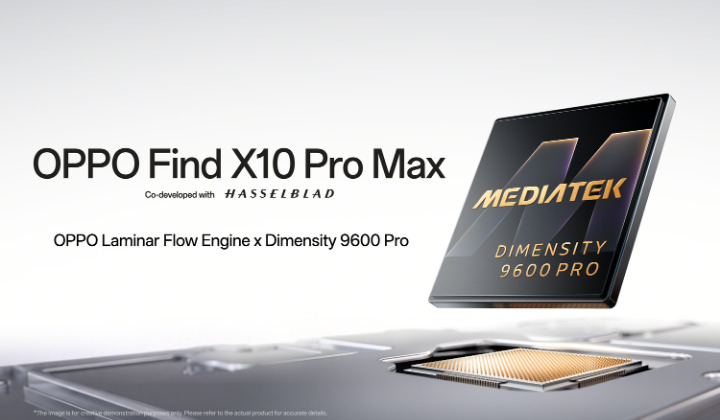
Oppo teamed up with MediaTek to co-develop a feature called the Laminar Flow Engine, designed to strike a sweet spot between snappy performance and low battery drain by re-architecting the rendering process to match system scheduling.
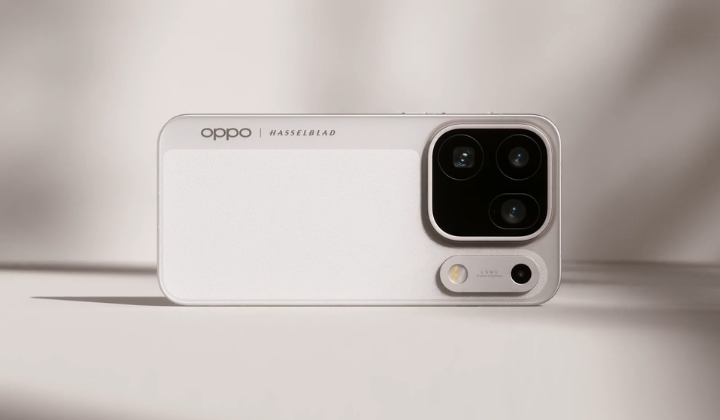
Expect that flagship phone to land globally sometime next month after their launch in China this month.